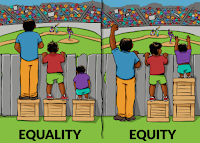
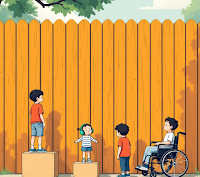
This is what happens when systems chase the appearance of fairness instead of the reality of access, safety, and learning.
When “Everyone Gets the Same” Becomes a Source of Harm
In some early childhood programs and school initiatives (I will refrain from mentioning here), “equity” has quietly been redefined as “everyone gets exactly the same, all the time.” Everyone gets the same sticker, the same snack, the same words of praise. No one is told “no,” no one receives corrective feedback, no one is given a visible individualized system-because anything different is labeled unfair, stigmatizing, or “shaming.”
Staff are discouraged or outright prohibited from using tools like token boards, reinforcement systems, or individualized consequences, even when these are thoughtfully designed and evidence‑based. The tools themselves are called public shaming, while the very real public struggle of a child in crisis is somehow treated as neutral or even kind.
Here’s how that looks in real life.
- A child is asked to put toys away but has never truly been taught:
- why it matters in a group, or how to move from preferred to non‑preferred tasks.
He melts down for 45 minutes on the floor. Staff “comfort” him as best they can (hugs, sensory strategies/tools, choices, bribes), but there is no clear teaching, no plan, and no path forward. In the process, he may hit, kick, or hurt himself. The class loses instructional time. Peers watch, confused and uncomfortable. The child is legitimately upset-his nervous system is in survival mode-but he is not gaining understanding, skills, or a sense of competence. He is living through a traumatic experience inside the school day.
Now contrast that with a thoughtfully designed, individualized system.
The same child is explicitly taught (instruction and practice) what “clean up” looks like with supports individually tailored- visuals, modeling, rehearsal during calm moments, and a predictable routine. He has a token or reinforcement plan that makes the value of following directions concrete and meaningful to him. When he struggles or refuses, adults respond with a blend of:
- proactive support by teaching contingencies (individualized prompting, choices, visuals),
- reinforcement for even small steps in the right direction, and
- reasonable, consistent, clinically sound punishment procedures (corrective feedback, loss of access to a privilege directly connected to the situation, having to complete a task later) that are planned, ethical, and focused on teaching, not hurting
Over time, he learns: “I can do hard things. I know what is expected. My actions matter.” He experiences success in front of his peers. He feels more capable.
Imagine this; refusing to provide a wheelchair because “then every child would need one,” or because it might look stigmatizing or make the child feel different. Instead, we carry her everywhere. She has no opportunity to develop autonomy, no expectation to explore her environment, no chance to experience the small challenges and successes that build true confidence. In the real world, we do the opposite: we provide the wheelchair, we teach her how to use it, and we expect her to become as independent as possible-only carrying or pushing when it is absolutely necessary. Withholding individualized behavioral and learning supports in the name of “fairness” is like withholding the wheelchair. It does not protect self‑esteem; it quietly erodes it.
When we strip away individualized supports in the name of “fairness,” we do not eliminate shame; we amplify it. The child who repeatedly melts down in front of everyone, never gets through the task, and never experiences genuine success will almost inevitably:
- Fall further behind academically and behaviorally.
- Develop a more fragile or negative self‑image.
- Associate adults, school, and expectations with humiliation and overwhelm rather than growth.
As Leland Vittert, the author of Born Lucky said, "self‑esteem is earned". It is not handed out with identical stickers; it is built when children experience themselves as capable and see a meaningful connection between their efforts and outcomes.
What Authentic, Compassionate, Trauma‑Informed Education Actually Is
Authentic, compassionate, trauma‑informed education is not:
- Avoiding all corrective feedback.
- Refusing to individualize supports because someone might notice or the other children might feel left out.
- Calling any structured consequence “harmful” without looking at context and function.
Instead, it is a way of designing environments, instruction, and responses that:
- Assume there is more to the story than what we see in the moment.
- Prioritize emotional and physical safety, including safety from repeated, unmanaged dysregulation.
- See behavior as communication and skill gaps, not just defiance.
- Pair high expectations with high levels of teaching and support.
- Honor dignity and autonomy while also teaching boundaries, limits, and responsibility.
In a truly trauma‑informed classroom:
- Reinforcement is used generously and intentionally to build skills, motivation, and connection.
- Corrective feedback is clear, calm, and consistent-not humiliating, but also not avoided.
- Individualized systems (visuals, token boards, behavior plans) are viewed as access tools, not as favoritism.
- Consequences are planned, proportionate, and tied to learning (“When I do X, Y happens”), rather than reactive or punitive.
Compassion does not mean allowing a child to remain in a pattern that harms them or others. Compassion means doing the harder, more thoughtful work of teaching them something better.
The Dangers of Working Outside Authentic, Trauma‑Informed Practice
Authentic, compassionate, trauma‑informed education is not:
- Avoiding all corrective feedback.
- Refusing to individualize supports because someone might notice or the other children might feel left out.
- Calling any structured consequence “harmful” without looking at context and function.
Instead, it is a way of designing environments, instruction, and responses that:
- Assume there is more to the story than what we see in the moment.
- Prioritize emotional and physical safety, including safety from repeated, unmanaged dysregulation.
- See behavior as communication and skill gaps, not just defiance.
- Pair high expectations with high levels of teaching and support.
- Honor dignity and autonomy while also teaching boundaries, limits, and responsibility.
In a truly trauma‑informed classroom:
- Reinforcement is used generously and intentionally to build skills, motivation, and connection.
- Corrective feedback is clear, calm, and consistent-not humiliating, but also not avoided.
- Individualized systems (visuals, token boards, behavior plans) are viewed as access tools, not as favoritism.
- Consequences are planned, proportionate, and tied to learning (“When I do X, Y happens”), rather than reactive or punitive.
Compassion does not mean allowing a child to remain in a pattern that harms them or others. Compassion means doing the harder, more thoughtful work of teaching them something better.
The Dangers of Working Outside Authentic, Trauma‑Informed Practice
When we drift into a “no one is ever uncomfortable, everyone gets the same” model, several predictable harms emerge:
Students with disabilities and complex needs fall further behind.
- They are given the same expectations and supports as everyone else, then blamed-quietly or openly-when they cannot meet them.
- Trauma is re‑created instead of reduced.
- Being out of control, scared, or overwhelmed alone or in front of peers, over and over, is its own kind of trauma. Doing nothing or doing something meaningless to change that pattern is not neutral.
- Staff feel powerless and burned out.
- When adults are told, “You can’t use that tool,” but are still responsible for safety and learning, their own nervous systems stay in survival mode.
- “Kindness” becomes performative.
- We talk a lot about feelings and fairness, but we avoid the real work of skill‑building, boundary‑setting, and repair.
Working outside authentic, compassionate, trauma‑informed practice doesn’t just fail to help; it actively widens the gap between students who are coping and those who are drowning.
When We Get It Right: Compassion With Backbone
When schools reclaim authentic trauma‑informed, evidence‑based practice, the picture changes:
- Different kids get different tools, and that is openly accepted as fair when it's what they need [the flip side is throwing all available accommodations at the child but that's for another blog]
- Reinforcement is available and intentional-also systematically faded and more natural.
- Corrective feedback is calm, specific, and predictable, not emotional or shaming.
- Students learn coping, communication, and “how to do school” skills, not just academics.
- Self‑esteem is earned through real mastery, not inflated through empty praise.
This is the balance I help schools and programs find through Practical Solutions for Behavior and Instruction LLC: compassionate, progressive, ABA‑informed systems that honor students’ nervous systems and histories while still teaching boundaries, responsibility, and genuine, lasting skills.
If your team is wrestling with these questions-How do we be gentle without being passive? How do we uphold expectations without re‑creating harm?-I would be glad to partner with you in building supports that are both kind and effective, for students and staff alike.
www.pracsol4u.com
practicalsolutions.jw@gmail.com
(949) 287-3683